
Some companies may release a deep exhale following a proxy season without engagement from an activist shareholder. The feeling of relief should be short-lived – when proxy season ends, activist investor hunting season begins. Activists are currently screening for companies with low shareholder support, margin compression and lagging shareholder returns as they zero in on their targets for the 2019 proxy season.
Despite the consistent volume of and the decibel levels of public activist campaigns, many executives and board members remain blind to their vulnerabilities and are undereducated about the proxy contest process, the critical role that proxy advisory firms such as ISS and Glass Lewis play, and the time, cost and risk associated with a contested situation.
Proxy Battle Basics
The Role of Proxy Advisory Firms
These firms, most notably ISS and Glass Lewis, provide research for institutional shareholders regarding vote recommendations at shareholder meetings. Institutional Shareholder Services (“ISS”) has roughly 1,900 clientsi with a 60% market shareii and Glass Lewis controls another 1,300 clientsiii with a 36% market share. Together, they play a critical role in vote outcomes.
| Why do Money Managers engage Proxy Advisory Firms? Money Managers outsource proxy voting activities to proxy advisors in an effort to reduce cost and complexity while ensuring compliance. The scale of proxy season is overwhelming. Consider the average company may have as many as 10 proxy votes a year including auditor, board, compensation and other proposals. Multiply this number by the number of names in a portfolio which can range from 30 to over 100. Then multiply that number by the number of different products that a money manager may offer (think 5 to 100 different products). Finally, tabulate votes on an account level (separate accounts, mutual funds, e.g.). It’s important to note that most proxy voting occurs in a 3-4 month window. ISS employs over 900 people in order to cover the 40,000 meetings of publicly traded companies each year. |
Time, Costs & Risks
Proxy battles are extremely time consuming and a distraction to executives, boards, employees and customers. They divert time and attention away from running the core business. Our experience suggests that the average executive team devotes in excess of fifteen hours a week to a proxy battle while lead directors and board members devote additional hours to extended board and proxy-related meetings.
Not only are proxy contests extremely time consuming, but the costs associated with a proxy battle can also quickly balloon as the activist situation escalates. The average cost for a U.S. listed company to engage in a proxy fight is $4.8 million.iv Proctor & Gamble’s 2017 proxy battle with Trian has been estimated to cost the company over $35 million.v
Executives and board members must expect to face intense public scrutiny and criticism over their stewardship of the company, which can lead to reputational and career damage. One only needs to look at the public letters issued by Paul Singer’s Elliott Management in its criticism of Arconic to get a sense of the nature and tone of the charges being brought by a proxy fight.
Given the time, expense and reputational risk associated with a proxy contest, how should a board decide to proceed when engaged by an activist? There are several factors that influence the outcomes of proxy contests, so it is extremely important to isolate the most important factors as a basis for timely decision making.
Implications
History as a Guide
The overwhelming volume of value and shares that rely on a proxy advisor’s vote recommendations show the proxy advisor’s significant influence on proxy contest outcomes. From 2013 through 2018 proxy season,vi there were approximately 700 US based contentious/activist situations. Out of 700 activist situations, approximately 520 were settled or withdrawn leaving over 150 proxy contests. During that period, if proxy advisor Glass Lewis recommended a full or partial dissident shareholder slate of directors, a dissident director was elected 69.7% of the time. Over the same period, if ISS recommended a full or partial dissident shareholder slate, a dissident shareholder was elected 76.2% of the time. Moreover, if both ISS and Glass Lewis recommended a full or partial dissident shareholder slate, a dissident nominee would be elected 77.7% of the time.
The Importance of Total Shareholder Return (TSR)
The evaluation frameworks used by both ISS and Glass Lewis address multiple dimensions including, but not limited to, a company’s operations, capital allocation, corporate governance, executive compensation and Total Shareholder Return in relation to both its peers and its relevant indices. Of those factors, our analyses reveal that TSR may be the most significant variable in determining the proxy advisors’ vote recommendations.
| Total Shareholder Return is the change in share price over a period of time including the impact of dividends and corporate actions such as spinoffs and stock splits. |
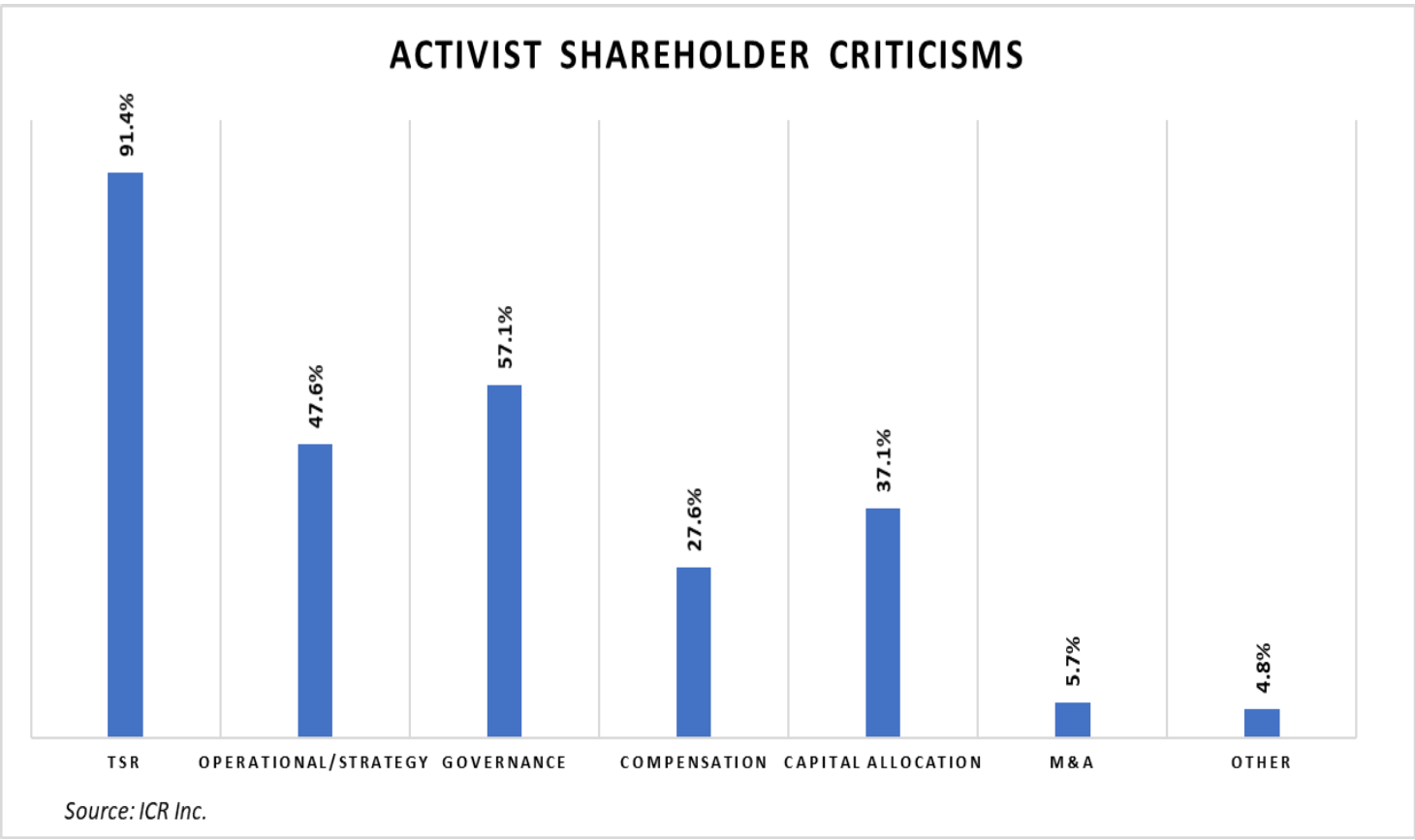
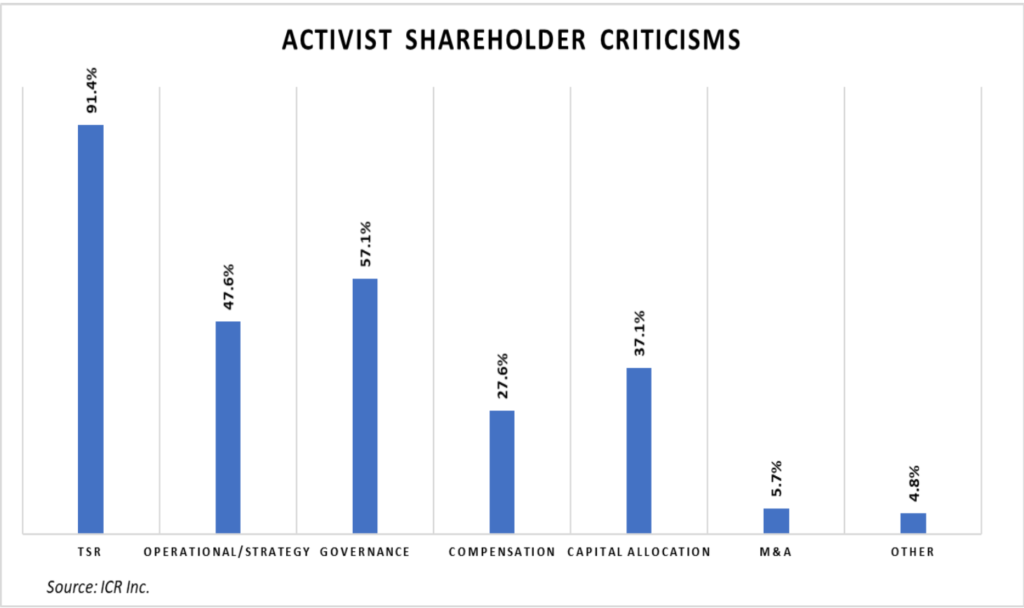
Since 2013, in 91.4% of contested elections the dissident shareholder has cited poor shareholder return as a reason for change at the board level. Over the same period, ISS has issued a vote recommendation for a dissident slate when the company has outperformed its ISS defined peer group on a backward looking 3-year and 5-year basis less than 3% of the time. ISS has consistently recommended a partial or full dissident slate when a company has significantly underperformed its ISS defined index and ISS defined peer group.vii Based on the median values, when ISS has
recommended a partial or full dissident slate, the company has dramatically underperformed its ISS defined peers and ISS defined index.
ISS has recommended a dissident slate when the company has outperformed its ISS defined peer group on a 3-year and 5-year basis less than 3% of the time
| ISS Recommends for Partial or Full Dissident Slate | ||
| Versus Peers | 3-Year TS R (in ppts) | 5-Year TS R (in ppts) |
| Median Underperformance vs . P eers | -27.4 | -17.5 |
| Range of P erformance vs . P eers | (-123.7 to 29.8) | (-185.0 to 566.0) |
| Versus Index | ||
| Median Underperformance vs . Index | -34.1 | -32.5 |
| Range of P erformance vs . Index | (-168.7 to 57.4) | (-235.9 to 546.0) |
Thoughts for Boards, Executives and Investors
Unfortunately, by the time a proxy advisor opines on a contested election, it is too late to take actions to address TSR. In fact, it may be too late to address TSR deficiencies when an activist begins to accumulate shares in your company. While Total Shareholder Return is just one data point, it is a critical one. It serves as an important metric for companies to monitor and understand how to manage its components. Managements and boards should have formal policies and frameworks to routinely assess their vulnerabilities to activists and consider what actions can be taken to address TSR performance.
Dan McDermott is the founder of VL Communications and is an adjunct professor of Shareholder Activism at University of Pennsylvania Law School. He is a former Senior ISS Proxy Contest Analyst.
Dan@vlcommunications.com
www.vlcommunications.com
i About Institutional Shareholder Services: https://www.issgovernance.com/about/about-iss/
ii Wall Street Journal: https://www.wsj.com/articles/james-k-glassman-regulators-are-a-proxy-advisers-best-friend-1418863046
iii Glass Lewis Company Overview: http://www.glasslewis.com/company-overview/
iv Activist Insight: http://www.valuewalk.com/2014/09/proxy-fights-costs/
v Cincinnati Business Journal: https://www.bizjournals.com/cincinnati/news/2017/08/02/p-g-expects-proxy-battle-to-cost-35-million.html
vi From 1/1/2013 through 8/5/2018
vii ISS and Glass Lewis internally construct custom peer groups and peer indices for virtually every proxy battle